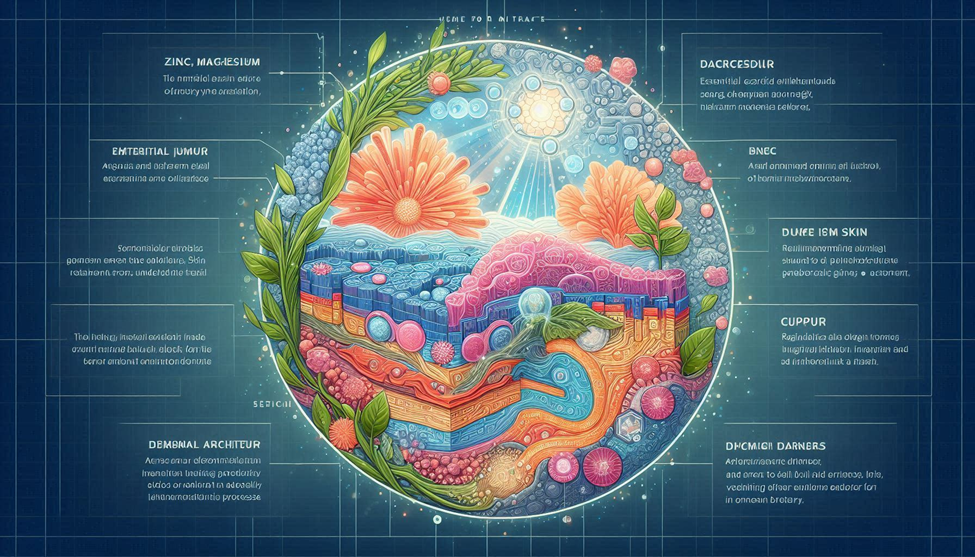
Introduction: The Forgotten Architecture beneath the Skin
Minerals are often treated as secondary nutrients—supportive, passive, background players. Yet within the skin barrier, they are architectural molecules, structural engineers shaping lipid organization, creamed synthesis, collagen cross-linking, keratinocyte turnover, microbial balance, barrier tightness, and antioxidant defense.
The skin barrier—especially the stratum cornea and its lipid-protein scaffolding—relies heavily on these ionic building blocks. Zinc orchestrates DNA repair and immune surveillance; magnesium stabilizes ATP-dependent enzyme systems and maintains barrier hydration; copper catalyzes collagen and elastic maturation while acting as a redo buffer. Together, they create what can only be described as a Mineral Dermal Architecture: a three-layered, mineral-dependent system that defends, regenerates, and corrects.
In a world filled with barrier-disrupting stressors—oxidative damage, pollution nanoparticles, emotional stress chemistry, gyration, micro biome shifts, skin dehydration, inflammatory diets—supporting the mineral matrix becomes essential. This article maps how zinc, magnesium, and copper operate at the deepest biochemical levels to rebuild the barrier, restore epidermal order, and guide the skin back to homeostasis.
1. The Mineral Blueprint of the Skin Barrier
The skin barrier is not passive. It is a bioactive membrane regulated by ions, enzymes, electrical gradients, and micro-signals. Each mineral acts at a different structural level:
- Zinc: genomic repair, keratinocyte differentiation, antimicrobial balance
- Magnesium: ATP activation, hydration gradients, enzymatic stability
- Copper: collagen architecture, elastic integrity, redo buffering
Their roles are complementary rather than redundant, forming a tri-mineral framework:
| Mineral | Barrier Role | Molecular Level |
| Zinc | immune surveillance, DNA repair, anti-inflammatory | zinc-finger proteins, metallothioneins |
| Magnesium | hydration, ATP-dependent lipid synthesis | enzymatic cofactor, barrier osmoregulation |
| Copper | collagen-elastic cross linking, antioxidant defense | Lysol oxidize, superoxide dismutase |
When these minerals are insufficient, the barrier collapses at multiple levels: lipid dysfunction, impaired keratinization, collagen disorganization, oxidative stress, and increased transepidermal water loss (TEWL).
To understand barrier recovery, we must explore how each mineral functions as a cellular architect.
2. Zinc: The Barrier’s Master Regenerator
2.1 Zinc as a Structural Mineral
Zinc is fundamental to epidermal biology, participating in:
- Over 300 enzymes
- Over 1,000 zinc-finger transcription factors
- DNA and RNA polymerase function
- Keratinocyte maturation
- Collagen remodeling
- Microbial regulation
Zinc deficiency is often visible before it is measurable: dry, flaky skin, increased acne, slow healing, and barrier sensitivity.
2.2 Zinc and Keratinocyte Differentiation
Keratinocytes require zinc to transition through their life cycle:
- Basal cell proliferation
- Spinouts layer protein synthesis
- Granular layer lipid and flagging formation
- Stratum cornea certification
Zinc activates:
- Zinc-dependent metalloproteinase’s for controlled remodeling
- Zinc-finger proteins for genomic signaling
- DNA repair enzymes protecting keratinocyte integrity
Zinc also promotes expression of flagging, a critical barrier protein responsible for natural moisturizing factor (NMF) production.
Where flagging is disrupted—eczema, atopic dermatitis, TEWL—zinc replenishment often improves moisture retention and keratinocyte cohesion.
2.3 Zinc for Lipid Barrier Formation
Zinc influences:
- Creamed synthesis
- Free fatty acid balance
- Cholesterol etherification
- Membrane stabilization
It supports β-glucocerebrosidase, the enzyme that converts glucosylceramides to creaminess—one of the most essential steps for a watertight barrier.
Low zinc = low creaminess = chronic dryness.
2.4 Zinc and Immune Regulation (Anti-Inflammatory Architecture)
Zinc acts like an immunomodulatory “dial,” suppressing excessive inflammatory signals:
- Inhibits NF-be, the master inflammation pathway
- Lowers IL-6, TNF-α, IL-17
- Supports T-rag immune tolerance
- Balances neutrophil activity to avoid tissue damage
This is why zinc is widely beneficial for:
- Acne
- Eczema
- Resaca
- Wound healing
- Per oral dermatitis
It reduces the inflammatory “noise” that degrades barrier lipids.
2.5 Zinc and the Skin Micro biome
Zinc acts as a microbial balancer, not a broad antiseptic:
- Inhibits pathogenic bacteria like Cut bacterium acnes
- Supports beneficial strains (e.g., S. epidermidis)
- Reduces sebaceous inflammation
- Prevents biofilm formation
This creates a healthy microbial envelope, reinforcing the barrier’s chemical defense.
3. Magnesium: The Barrier’s Hydration Engineer and Enzymatic Stabilizer
3.1 The ATP–Magnesium Complex
Magnesium is not merely a mineral; it is a biochemical ignition key.
ATP—the cell’s energy molecule—must bind to magnesium to become active.
In other words:
No magnesium = no ATP activation.
No ATP = no lipid production.
No lipids = no barrier.
Barrier repair depends heavily on ATP-dependent processes:
- Creamed synthesis
- Fatty acid elongation
- Cholesterol metabolism
- Protein translation
- Ion pump regulation
Thus, magnesium ensures the barrier has energetic fuel.
3.2 Magnesium and Skin Hydration (TEWL Regulation)
Magnesium supports osmotic balance and water retention by:
- Regulating aquaporins (water channels)
- Protecting NMF components
- Preventing electrolyte-driven dehydration
- Enhancing lamellar lipid arrangement
Magnesium also reduces TEWL by stabilizing tight junction proteins such as:
- Claudin-1
- Occluding
- Zonal occludes (ZO) proteins
Where tight junctions weaken—sensitive skin, inflammation, irritant reactions—magnesium helps seal the permeability barrier.
3.3 Magnesium and Stress Chemistry: The Cortical–Barrier Link
Chronic stress leads to:
- Cortical-induced creamed depletion
- Fila grin suppression
- Lipid per oxidation
- Collagen breakdown
- Micro biome imbalance
Magnesium acts as a buffer against this stress cascade by lowering:
- Cortical
- Adrenal hyper activation
- Sympathetic overdrive
- Mast cell degranulation
This is why magnesium often reduces:
- Redness
- Itchiness
- Dermatitis flares
- Stress-induced breakouts
It calms both the nervous system and the epidermal barrier.
3.4 Magnesium as an Anti-Inflammatory Mineral
Magnesium regulates inflammatory signaling by:
- Suppressing NF-be (similar to zinc)
- Blocking calcium overload pathways that trigger inflammation
- Supporting antioxidant enzymes (via ATP activation)
- Reducing mast cell activity
It is particularly beneficial in:
- Psoriasis
- Atopic dermatitis
- Irritant dermatitis
- Barrier erosion from harsh actives
Magnesium is, in many ways, the barrier’s anti-irritation mineral.
4. Copper: The Collagen Architect and Oxidative Shield
4.1 Copper and Dermal Structural Proteins
Copper is essential for the extracellular matrix (ECM) architecture:
- Collagen
- Elastic
- Glycosaminoglycans
- Dermal fibrils
Without copper, collagen and elastic remain incomplete, unstable, and prone to degradation.
4.2 Copper and Lysol Oxidize (LOX): ECM Cross-Linking
The enzyme Lysol oxidize (LOX) depends entirely on copper.
LOX enables:
- Collagen cross-linking
- Elastic cross-linking
- ECM tensile strength
- Wound tensile recovery
- Dermal matrix organization
Copper deficiency translates into:
- Sagging
- Wrinkles
- Weak wound healing
- Loss of dermal firmness
You can have abundant collagen, but without LOX, collagen is structurally “loose.”
4.3 Copper Peptides (GHK-Cu) and Skin Regeneration
GHK-Cu is a copper-binding tri-peptide that:
- Increases collagen I, III
- Enhances elastic and fibronectin
- Activates stem cell pathways
- Improves dermal density
- Reduces oxidative stress
- Enhances wound healing
GHK-Cu works as both signaling molecule and mineral delivery mechanism.
4.4 Copper and Antioxidant Defense (SOD Pathways)
Copper forms part of Cu/Zn-superoxide dismutase (SOD1)—one of the body’s most crucial antioxidants.
SOD1 neutralizes superoxide radicals, reducing:
- Oxidative stress
- Photo aging
- Pollution-induced damage
- Collagen fragmentation
Copper therefore strengthens the barrier at the antioxidant level.
4.5 Copper and Angiogenesis
Copper promotes healthy blood vessel function, ensuring nutrient delivery and oxygenation.
This supports:
- Glowing complexion
- Wound healing
- Even skin coloration
- Reduction in dullness
Without copper, microcirculation stagnates, and the skin loses vitality.
5. Mineral Synergy: How Zinc, Magnesium, and Copper Work Together
Minerals rarely operate alone—they form functional triads.
5.1 The Zinc–Copper Immune Axis
Zinc controls inflammation; copper controls oxidative stress.
Together they balance:
- Neutrophil reactivity
- Microbial resilience
- Redo stability
- Tissue repair
They also share SOD1, forming an antioxidant partnership.
5.2 The Magnesium–Zinc Barrier Duo
Both suppress NF-be.
Both support keratinocyte differentiation.
Both improve creamed and lipid production.
Magnesium improves ATP supply; zinc orchestrates gene expression.
Together they enable:
- Accelerated healing
- Enhanced moisture retention
- Better lipid membrane formation
5.3 The Copper–Magnesium Structural Interface
Magnesium ensures enzymatic energy; copper directs collagen organization.
Together, they enhance:
- ECM strength
- Dermal hydration
- Fibroblast activity
- Barrier renewal
This tri-mineral synergy forms the Mineral Dermal Architecture.
6. Mineral Deficiencies: Hidden Barrier Breakers
Many skin issues reflect underlying mineral deficits:
Zinc Deficiency Signs
- Acne
- Slow wound healing
- Redness
- Dermatitis
- Cracked skin
- Infections
Magnesium Deficiency Signs
- Sensitivity
- Roughness
- High TEWL
- Stress-related flares
- Atopic predisposition
Copper Deficiency Signs
- Loss of elasticity
- Sagging
- Pale complexion
- Poor wound healing
- Wrinkles beyond age
Modern behaviors—stress, processed foods, inflammation, medication use—can reduce absorption or increase mineral loss.
7. Diet: How to Eat for Mineral Skin Rebuilding
7.1 Zinc-Rich Skincare Nutrition
- Pumpkin seeds
- Chickpeas
- Eggs
- Seafood
- Lentils
- Yogurt
- Cashews
7.2 Magnesium-Rich Foods
- Leafy greens
- Almonds
- Dark chocolate
- Whole grains (gluten-free options: quinoa, buckwheat)
- Avocado
- Seeds
7.3 Copper-Rich Foods
- Organ meats
- Oysters
- Cacao
- Sesame seeds
- Cashews
- Mushrooms
- Chickpeas
Balanced intake supports the tri-mineral architecture.
8. Mineral Topical: When and Why They Work
Zinc Topical
- Zinc PCA for oil regulation
- Zinc oxide for barrier repair
- Zinc glaciate for acne
- Speeds wound healing
- Reduces irritation
Magnesium Topical
- Magnesium chloride sprays
- Epsom salt (magnesium sulfate) baths
- Magnesium creams for sensitivity
Copper Topical
- Copper peptides (GHK-Cu)
- Copper amino complexes
- Copper oxide dressings for healing
Formulation matters. Mineral salts absorb differently based on:
- pH
- Chelating
- Vehicle (oil, gel, water)
- Molecular size
Zinc PCA and GHK-Cu are the gold standard.
9. Mineral Derma-Repair Protocol (Professional Level)
- Morning
- Zinc PCA (0.3–1%)
- Niacin amide (zinc synergy)
- Copper peptides (alternate days)
- Sunscreen fortified with zinc oxide
- Night
- Magnesium creams or sprays
- Creamed-rich moisturizer (magnesium-activated lipid synthesis)
- GHK-Cu serum or cream every 48 hours
- Weekly
- Epsom salt (Mg) bath soaks
- Zinc-rich meals
- Copper-rich plant foods
- For Damaged Barriers
- Prioritize magnesium → zinc → copper
- Avoid copper until inflammation is controlled
10. Mineral Architecture for Specific Skin Types
- Acne-Prone
- High zinc
- Moderate magnesium
- Low copper initially
- Sensitive/Barrier-Damaged
- High magnesium
- Moderate zinc
- Minimal copper
- Aging/Sagging Skin
- High copper
- Moderate zinc
- Moderate magnesium
- Hyper pigmentation
- Zinc for melanocyte regulation
- Copper peptides for dermal remodeling
- Magnesium for hydration
11. The Future of Mineral Dermatology
Emerging research highlights:
- Mineral nanoparticles for targeted delivery
- Mineral-micro biome interactions
- Bio-ionic topical systems
- Mineral-induced stem cell activation
- Electrically active skincare using mineral gradients
- Mineral peptides for deeper penetration
We are entering a new era of ionic dermatology, where minerals become not just supplements but active treatments.
Conclusion
The skin is not merely protected by minerals—it is constructed, regulated, and repaired by them. Zinc orchestrates keratinocyte proliferation, micro biome balance, inflammation control, and DNA repair. Magnesium energizes the enzymatic machinery that forms barrier lipids and hydration networks while buffering stress chemistry that sabotages the epidermis. Copper strengthens the architectural backbone of the skin—collagen, elastic, and micro vascular networks—while powering antioxidant enzymes that defend against oxidative aging.
Together, these minerals form a tri-layered Mineral Dermal Architecture, rebuilding the skin from the molecular level upward. Whether the barrier is damaged by stress, inflammation, aging, environmental toxins, or nutrient insufficiency, strategic mineral replenishment restores structural integrity. The future of dermatology lies in mineral-centered therapies that harness their regenerative abilities, biochemical intelligence, and ion-driven signaling.
Supporting zinc, magnesium, and copper through diet, topical, and targeted protocols transforms the skin into a more resilient, hydrated, youthful, and immune-balanced organ—one capable of repairing itself with architectural precision.
SOURCES
Lopez Garcia 2016. Role of trace minerals in epidermal homeostasis and barrier repair. Journal of Dermatological Science.
Market 2013. Zinc biochemistry: Functions, mechanisms, and regulation. Bimetals.
Oland 2020. Zinc in keratinocyte biology and inflammatory skin disease. Experimental Dermatology.
Prasad 2014. Zinc deficiency and its effects on skin immunity. Nutrients.
Palm & Outman 2021. The zinc–micro biome axis in skin health. Frontiers in Immunology.
Bionic 2015. Topical zinc PCA and sebum regulation. Clinical Cosmetic and Investigational Dermatology.
Rayssiguier 2010. Magnesium and its role in cellular energy metabolism. Magnesium Research.
Nielsen 2018. Magnesium and the regulation of inflammatory and oxidative processes. Current Opinion in Clinical Nutrition and Metabolic Care.
De Baoji 2015. Magnesium in health and disease: Transport, deficiency, and cellular roles. Physiological Reviews.
Dena 2019. Barrier function and magnesium-dependent epidermal signaling. Skin Pharmacology and Physiology.
Ganceviciene 2012. Stress, cortical, and their effect on the skin barrier. Derma to-Endocrinology.
Olsen 2017. The impact of psychological stress on epidermal lipids. Act Dermato-Venereologica.
Ditto 2021. Copper-dependent enzymes and ECM remodeling. Matrix Biology.
Pick art 2018. Copper peptides (GHK-Cu) and dermal regeneration. Journal of Aging Science.
Rucker 2009. Copper, Lysol oxidize, and connective tissue biology. Nutritional Biochemistry.
Fuci & Ushio-Fuci 2011. Copper/Zinc-SOD and oxidative defense. Antioxidants & Redo Signaling.
Kivirikko 2019. Collagen biosynthesis and mineral cofactor requirements. Biochemical ET Biophysical Act.
Kari 2020. Mineral regulation of keratinocyte proliferation and differentiation. International Journal of Molecular Sciences.
Hardman 2016. Trace elements and wound healing pathways. Advances in Wound Care.
Gupta 2014. Topical minerals in dermatology: Mechanisms and clinical benefits. Indian Journal of Dermatology.
Miller 2018. The zinc–copper immune balance in inflammatory disorders. Nutritional Immunology Reviews.
Sharquie 2015. Magnesium topical therapies for dermatitis and sensitive skin. Journal of Cosmetic Dermatology.
Borrow 2020. Copper oxide in wound repair and antimicrobial protection. Wound Repair and Regeneration.
HISTORY
Current Version
Nov 17, 2025
Written By
ASIFA